Bake Again
From tested recipes to guided cooking.
Bake Again grew out of years of gluten-free baking for my family. I wanted to make recipes I’d tested myself useful to others—not only as instructions to read, but as practical guidance while cooking.
Explore Bake AgainMy contribution
I brought the baking knowledge, defined the product and recipe model, guided the design and reviewed the implementation. AI generated the application code through this iterative collaboration.
Recipes that adapt
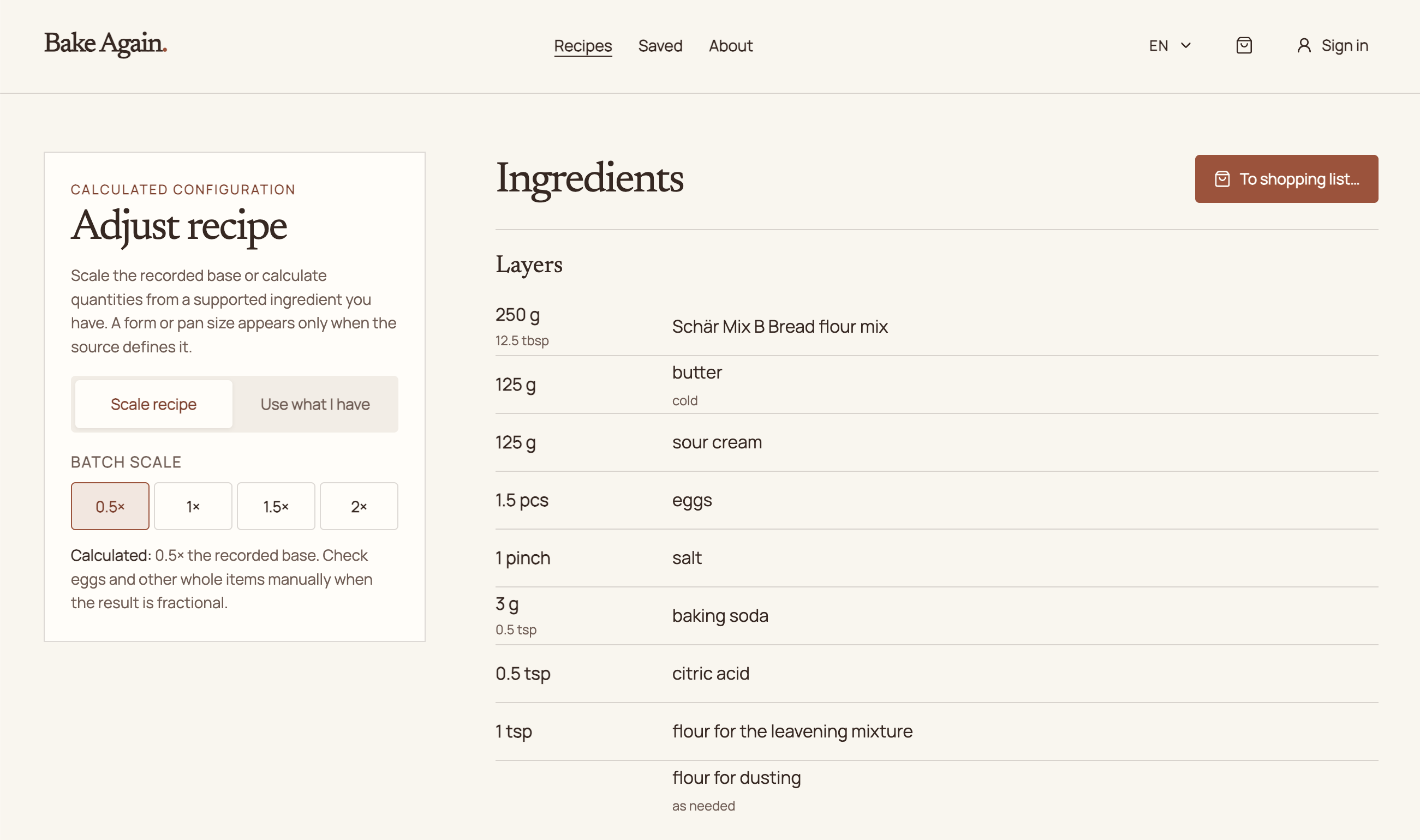
Changing a recipe means more than multiplying every ingredient. I shaped a shared model for quantities, components and cooking steps, so one adjustment carries through the recipe and Cook Mode.
At half the base quantity, the recipe calculates 1.5 eggs and flags the amount for the cook to check.
- Tested
- The exact version was baked.
- Calculated
- Quantities were adjusted mathematically.
- Suggested
- The proposed change has not been bake-tested.
Guidance while cooking
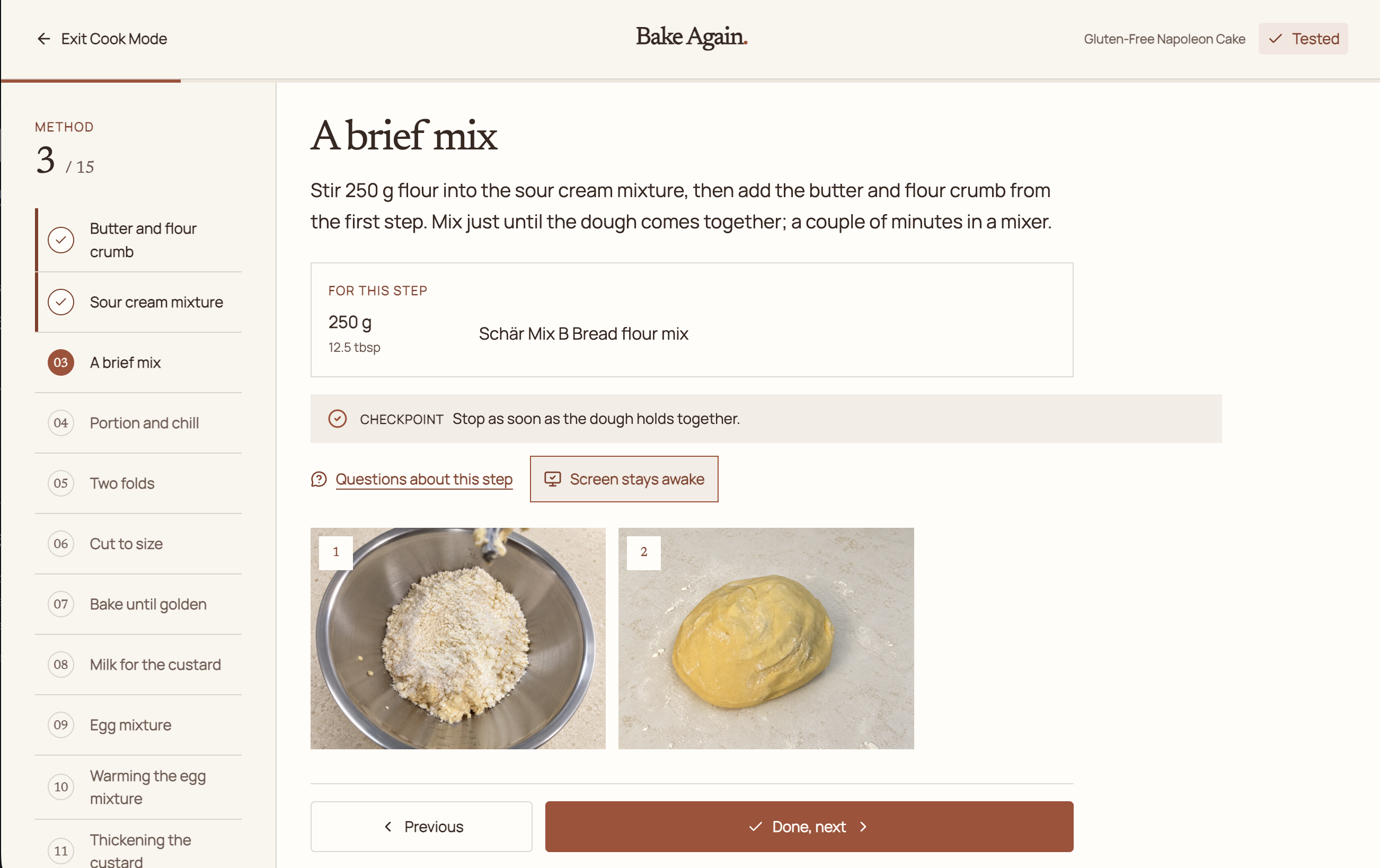
I wanted the recipe to remain useful once someone started baking. Cook Mode brings the current instructions, relevant ingredients, photographs and readiness checkpoints into one view.
For the mixing step, the cook can compare the dough with photographs and use a readiness checkpoint to decide when to stop.
Timing follows the process
The model distinguishes active work from elapsed time and connects preparation, waiting and cooking phases to specific steps. This lets different recipes share a structure while keeping their own sequence and timing.
Help in context
Common questions should be easy to answer without interrupting the cooking task. I separated prepared explanations from custom AI questions, with both grounded in the recipe and current step.
Prepared answers
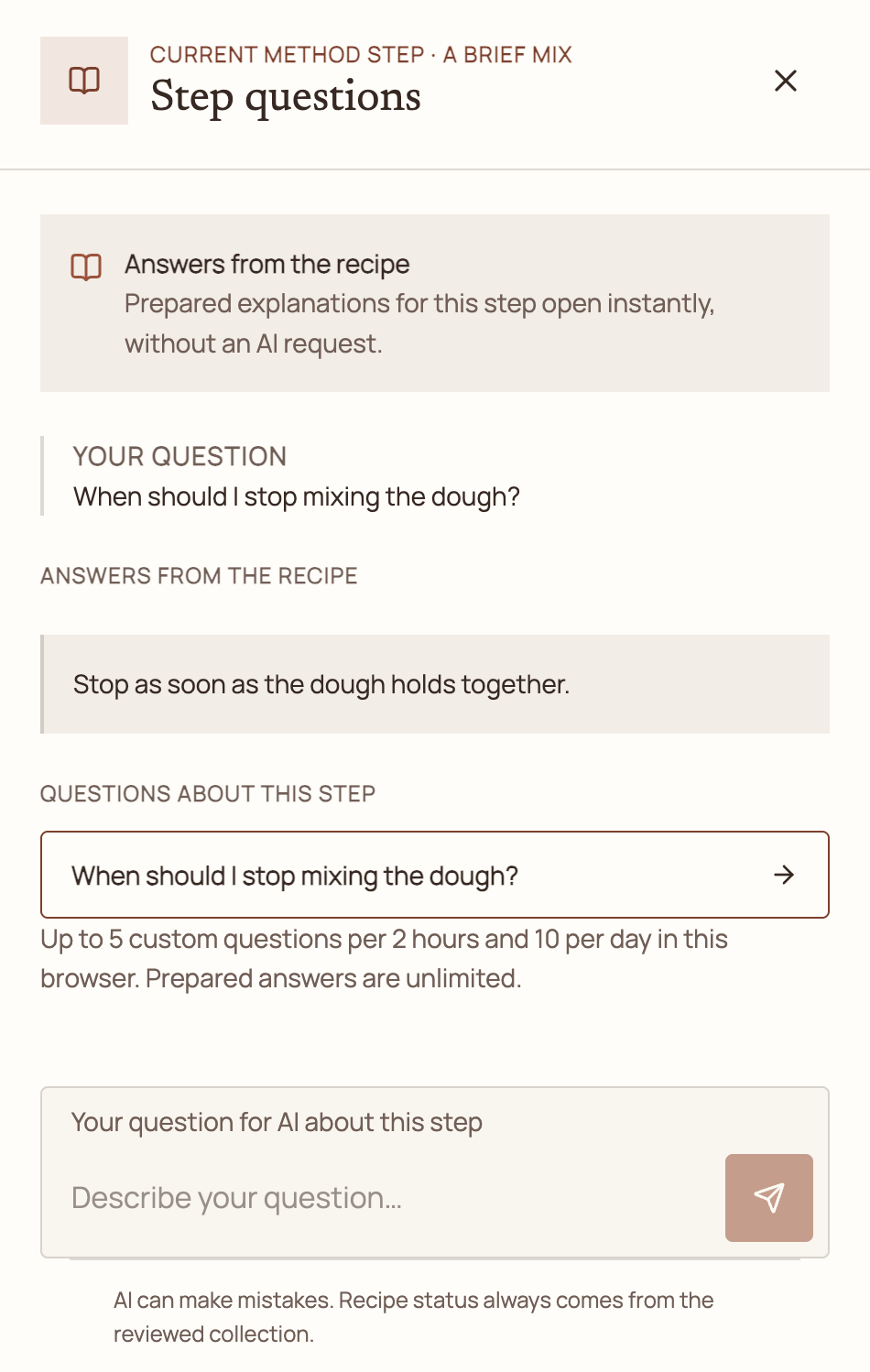
I used AI to prepare common questions in advance. Answers come from reviewed text and recipe guidance, adjusted to the selected configuration, without a new model request.
Custom AI questions
New questions use the recipe version, selected quantities, language and current step as context. Responses are checked against that context; AI cannot mark a recipe as Tested.
The screenshot shows a prepared recipe answer.
Direction through review
During implementation review, I asked to replace browser-import and manual-sync controls with a simpler flow: offer sign-in when someone wants to save a recipe or note.
Tested recipes.
Practical guidance.
Tested gluten-free recipes are now an interactive collection: cooks can adjust quantities, follow each step and get help in context.
Explore Bake AgainTechnical details
A shared recipe model supports Ukrainian, English and Spanish. Reader accounts, newsletter consent and product analytics have separate responsibilities.
Custom AI requests have limits on input size, response length, concurrency and timeouts. A shared quota service reserves a maximum cost before generation; requests are rejected when that service is unavailable. Structured responses and their references are validated against the recipe context.
Data checks, interface review and deterministic assistant evaluations cover the application’s rules and safeguards. Live AI answer quality requires its own evaluation.
- Application
- React · TypeScript · vinext / Vite
- AI & limits
- OpenAI Responses API · Turnstile · D1
- Services
- Supabase · PostgreSQL · Brevo · Umami